
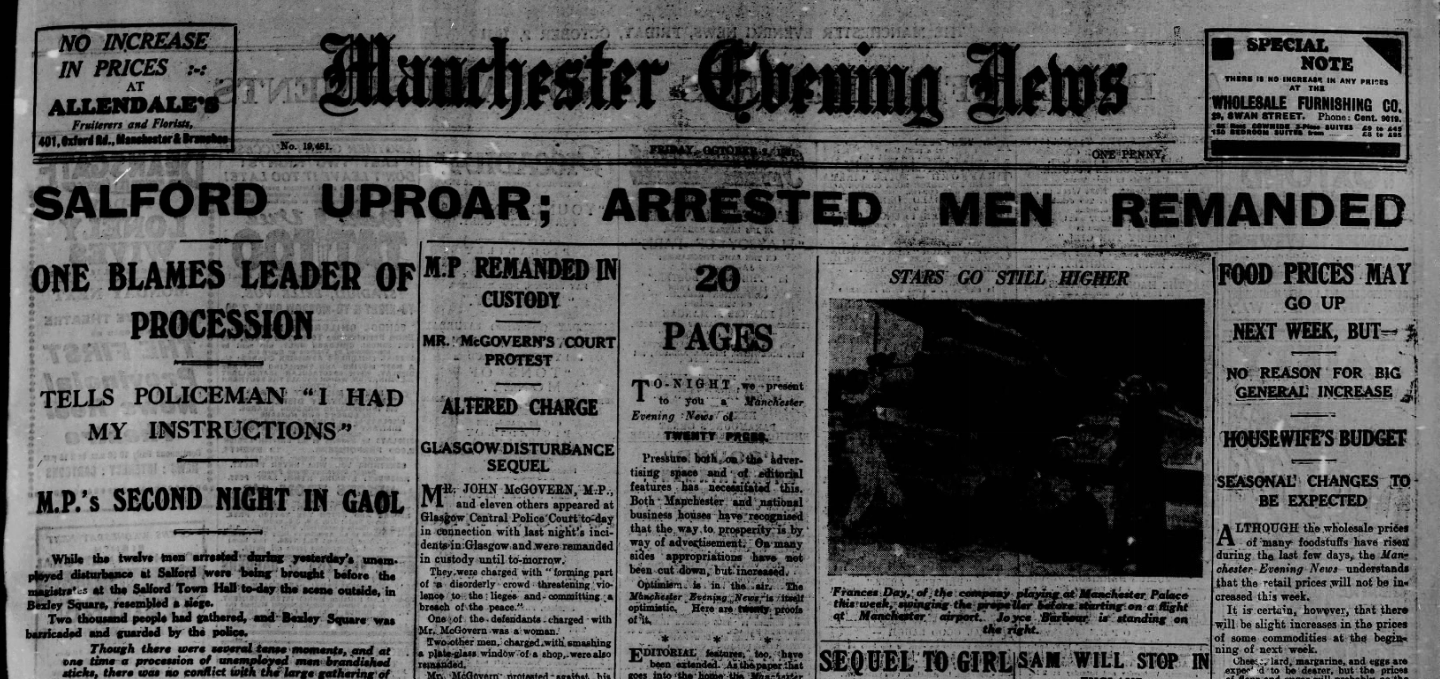

SALFORD UPROAR; ARRESTED MEN REMANDED
One Blames Leader of Procession
Tells policeman “I had my instructions”
Whilst the twelve men arrested during yesterday’s unemployed disturbance at Salford were being brought before the magistrates at the Salford Town Hall to-day the scene outside, in Bexley Square, resembled a siege.
Two thousand people had gathered, and Bexley Square was barricaded and guarded by the police.
Though there were several tense moments, and at one time a procession of unemployed men brandished sticks, there was no conflict with the large gathering of policemen.
All the twelve were remanded, ten on bail. One of the remaining two was refused bail because he would not promise not to demonstrate again, and the other was not given bail on the application of the police.
HOME SECRETARY’S ATTENTION
In the House of Commons to-day Mr. J. Toole raised the question of the Salford conflict, and was told that the Home Secretary was considering what steps could be taken.
Mr. McGovern, M.P., and others arrested in last night’s Glasgow disturbances were to-day at Glasgow police court remanded in custody until to-morrow.
Rochdale magistrates to-day granted summonses against the leaders of the demonstration which classed with the police yesterday.
M.P.s SECOND NIGHT IN GAOL
While the twelve men arrested daring yesterday’s unemployed disturbance at Salford were being brought before the magistrates at the Salford Town Hall to-day the scene outside, in Bexley Square, resembled siege. Two thousand people had gathered, and Besley Square: was barricaded and guarded by the police. Though there were several tense moments, and at one time a procession of men brandished sticks, there was no conflict with the large gathering of policemen. ‘All the twalve men were: remanded, ten on bail. One of the remaining two was refused bail because he would not promise not to demonstrate again, and the other – was not given bail on the application of the police.
Home Secretary’s Attention
In the House of Commons to-day Mr. J. Tools raised the question of the Salford conflict, and was told that the Home Secretary was considering what steps could be -taken. Mr. McGovern, M.P., and others arrested in last night’s Glasgow disturbances were to-day at Glasgow police: court remanded in custody until to-morrow. Rochdale magistrates to-day granted summonses- -against the leaders of the demonstration which clashed with the police yesterday.
THOUSANDS WAIT IN STREET.
Twelve men said to have been arrested during yesterday’s rush on Salford Town Hall appeared before the magistrates their names were given asGeorge Watson (34), Carlton Avenue, branch of Unemployed Broughton, seerstiona of the Salford Workers’ Movement. William Roberts (24), Sussex Broughton; Hugh Nelson (24), Ruth-street, Salford; James Rice (33), Arthur street, Pendleton; Harry Sandiford (35), Leganda-street, Salford; William Walters (21), Falkland Ave., Salford; William Dodd (35), Dean -street, Broughton; William Gibson Allen (28), Carterstreet, Greenheys, Manchester; Albert Edward Lister (31), no settled address; Edmund Frow (25), Stretford Road, Manchester; Clement Miller (30), Every Street, Salford; and Sidney Bullock (22), no settled address. They were charged singly with assault on the police and appeared in the dock one after the other. The proceedings were formal, as in each case except one the police applied for a remand until Thursday.
ONE DECLINES
Each man except one was asked to give an undertaking that he would take no part in any future hostile demonstrations or meetings before his next appearance in court. This promise was given by all men except one and they were allowed bail of £5 and one surety of £5. The man who refused to give the promise asked for was James Rice. He said, ” I will not give such an undertaking.’ The other man who was granted no bail was Albert Edward Lister. Sergeant Barnfield, on behalf- of- the police, opposed bail in his case because the police feared that he would not surrender to his bail.
Mr. F. Edwin Monks defended all the prisoners. The magistrates were Alderman George Billington (chairman), Mr. H. D. Moorhouse and Dr. J. Bradley.
The portion of the public gallery usually occupied by men was closed. Two policemen stood at the entrance, refusing admittance to anyone. The main body of the police court, however. was filled with people, chiefly women.
“I HAD INSTRUCTIONS”
The proceedings lasted twenty minutes and there was no excitement.
Several members of Salford City Council were present.
William Walters was the first prisoner to appear in dock.
Police-constable Noland said: “I arrested Walters in Bexley, Square, Salford. After charging him with assault on me he said, “Do not blame me. It was not my fault. It was that of the leader of the procession. I had my instructions from the marshal and I had to carry them out.”
The clerk, Mr. W. H. T. Foyster: I understand that a remand is asked for until Thursday so that inquiries may be made as to whether the men are genuine unemployed workers.
Mr.Detective Sergeant Barnfield: Yes.
Monks: I represent all the men, and I have no objection to bail.
Detective the police Sergeant Barnfeld pointed out that the police were prepared not to oppose bail in respect of all men excepting Lister, providing the men were prepared to give an undertaking that they would take no part in hostile demonstrations or meetings.
BLOW DENIED
The next man to appear in the dock was Clement Miller. Sergeant Miller said that Miller said to him after he had charged him with assault “I did not strike you, I only pushed you”. Miller said to the magistrates: 1 never struck him’.
The Clerk: You will be given an opportunity to state your case next Thursday.
Police Constable Settle said that in respect to Sidney Bullock that Bullock replied to the charge “I was full with red then.”
William Dodd was stated by Police Constable Parry to have said in reply to the charge “I am assaulting nobody, I am only fighting for my living.”
Edward Frow was charged with assaulting Superintendent Howard and Police Constable in Chapel-street. Superintendent Howard, said: “With the assistance of other officers I took Frow to the police station, and to the charge of assault, he said; : ‘ Yes; I understand.’ “
Frow is a tall, well-set-up man, and he appeared in the dock with his nose bandaged.
“I WAS EXCITED “
Police Constable Smith said that William Gibson Allen stated, in reply to the charge of assault, “I stand by the rest. I was excited.” Detective Sergeant Barnfield said, in opposing bail to Albert Edward Lister, that Lister had been living in the Salvation Army Home in Manchester, and that he was a native of Cumberland.
“He has been tramping the country and we are not sure of him”, said Detective Sergeant Barnfield. Police Constable Ford said that Lister replied to him when he charged him with assault. “I know all about it.” Lister asked the magistrates if they could tell him if he was being charged with the assault on Police Constable Ford, which necessitated the policeman’s hand having been bandaged.
The Clerk: You will have chance of stating your case next Thursday.
Lister was refused bail.
“I COULD NOT HELP IT”
Police. Constable Wagstaft said, respecting the charge of assault against William Roberts, that Roberts said “I was in it, although I could not help it”. Police Constable Southern said that he arrested Rice in Chapel street. He made no reply to the charge of assault.
Asked by the magistrates if he was prepared to give the promise of refusing to take part in any hostile demonstrations or. meetings until Thursday he said firmly. No. I will not give that undertaking.” He was refused bail.
“It was worth it,” was the reply alleged to have been made by Hugh Nelson to Sergeant Cooner when the police sergeant charged him with assault.
Sergeant – Needham said that George Watson said to him after he had charged him. “It serves you right.”
Harry Sandiford was the last. called and, according to Police -constable Wright in reply to the charge, “I have nothing to say.” Sandiford told the magistrates that he was not in the mob.
The Clerk: You may state your case next Thursday.
STICKS BRANDISHED
As soon as the crowds outside the Town Hall learned what had taken place in the police court they cheered wildly.
The men in Chapel-street formed a procession and marched down the street across the entrance of the square. There was a tense atmosphere as the crowd, probably 2,000 strong. marched towards the Square, some of them brandishing sticks. The police were not certain whether they intended to cause trouble and they prepared themselves. The crowd, however, passed the barricades and marched down Chapel-street. As they passed the police guard. which had now been further reinforced by about 20 more officers, rushed from the Town Hall, they cheered derisively. A large number of unemployed then moved along Oldfield Road, but, being unable to find any pitch to hold a meeting proceeded along Regent Road, Cross Lane, and Broad street into Leaf Square. A meeting was started here. Two youths mounted a lamp standard, holding a red flag and a large red cardboard scythe.
ROCHDALE SUMMONSES
Sequel to. Unemployed Clash with Police From Our Own Correspondent ROCHDALE, Friday.
Rochdale: magistrates granted summonses to-day against the leaders of the Rochdale unemployed in connection with the demonstration yesterday, when they clashed with the police. The summonses were for not conforming to an agreed route for the procession of the unemployed. Newspapers.com. Manchester Evening News, 2 October 1931. https://www.newspapers.com/article/manchester-evening-news/205073620/.
Home Secretary’s Action.
MR. J. TOOLE (Lab., Salford, S.) asked the Home Secretary in the House of Commons to-day. Whether he was aware of the serious disturbance of the peace which took place at Salford yesterday between police and the unemployed demonstrators;
Whether he had any statement to make on the matter, and whether, in view of the present national situation and the necessity for avoiding conflicts of this kind in this and other parts of the country, he would cause inquiries to be made.
Mr. O, Stanley (Under-Secretary): As the Home Secretary explained in a recent debate on the county and borough police, outside London the local police authorities are primarily responsible for the maintenance of law and order.
He has already taken steps to ascertain the facts and will certainly consider any action either of a particular or general character which he can usefully and properly take.
Sir A. Sinclair (Secretary for Scotland) replying to Mr. Maxton (Lab., Bridgeton) , said that according to his information, disturbances took place in Glasgow last night in Jail Square, Saltmarket, Glasgow Green, and other places.
A crowd of 50,000 met at the places mentioned at eight o’clock. Many armed with iron bars and batons. Windows were broken and the traffic was dislocated. There was no organised baton charge by the police, but several constables had to defend themselves when they were attacked.
Mr. Maxton : I want to ask the Government if they are going to take any notice of the causes of the disturbances or are they going to content themselves with measures of repression?
Sir A. Sinclair: No measures of repression have been undertaken in Scotland or in any other part of the country. The only measures which were taken in Glasgow last night were those taken by the magistrates to preserve the public right of passage.
Mr. Kirk wood’s Outburst
Mr. David Kirkwood (Lab., Dunbarton Burghs): I want to ask the Secretary for ‘Scotland if he will do what he can in order to change the demeanour of those in authority in Glasgow toward these poor people who are right up against it.
If there is nothing done, we are going back to Glasgow and you will have a chance of putting every one of us in gaol. You will take our lives or we will take yours. You can do any damn thing you like. Do you think we are going to stand by and see our people being batoned?
Mr Speaker: The clerk will now proceed to read the order of the day.
Newspapers.com. Manchester Evening News, 2 October 1931. https://www.newspapers.com/article/manchester-evening-news/205077329/.
